

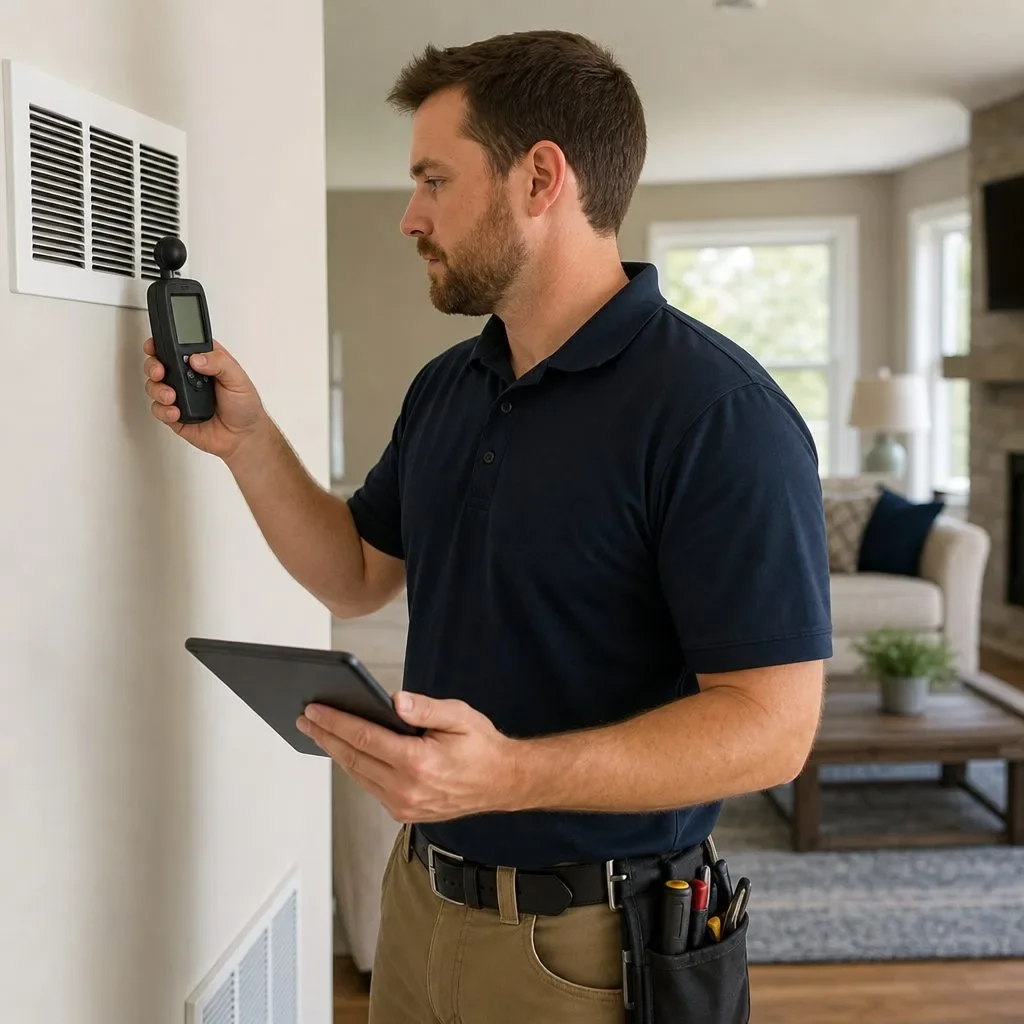
You Can't Fix What You Don't Measure
Most homeowners in South Bend know when something smells off or when allergies seem worse inside than outside. But identifying the actual cause? That takes more than a nose. An indoor air quality assessment gives you real data — specific readings that point to specific problems — so solutions are targeted, not guesswork.
Here's what a professional indoor air quality assessment actually measures, and why each component matters.
Particulate Matter (PM2.5 and PM10)
These are the tiny airborne particles suspended in your air — dust, pollen, pet dander, mold spores, and combustion byproducts. PM2.5 particles are small enough to penetrate deep into the lungs, and they're the most clinically significant.
An assessment uses a particle counter to measure concentration levels in micrograms per cubic meter. High readings often trace back to:
- Dirty or undersized air filters
- Leaky ductwork pulling in attic or crawl space air
- High-traffic areas without proper filtration
South Bend's humid summers and cold winters mean homes are sealed tight for months at a time — which is exactly when particulate buildup accelerates.
Volatile Organic Compounds (VOCs)
VOCs off-gas from building materials, furniture, cleaning products, paints, and adhesives. Low-level exposure over time can cause headaches, dizziness, and respiratory irritation. Some — like formaldehyde — carry more serious long-term risks.
During an assessment, VOC concentrations are measured in parts per billion (ppb). Elevated levels frequently trace back to new flooring or cabinetry, recently painted rooms, or products stored in attached garages.
Carbon Dioxide (CO₂) and Carbon Monoxide (CO)
These are two very different gases that often get grouped together.
CO₂ is a ventilation indicator. When levels creep above 1,000 ppm, it signals the space isn't exchanging air efficiently — occupants are rebreathe exhaled air, leading to fatigue and reduced cognitive performance.
CO is a safety issue. A colorless, odorless gas produced by combustion appliances (furnaces, water heaters, gas ranges), even low concentrations are dangerous. An assessment will check for CO presence and identify likely sources.
Relative Humidity
Humidity sits at the intersection of comfort and air quality. South Bend's climate swings hard — muggy summers push indoor humidity up, while winter heating pulls it down.
Too high (above 60%): Mold and dust mites thrive. Structural damage accelerates. Too low (below 30%): Mucous membranes dry out, increasing vulnerability to airborne viruses and bacteria.
An assessment logs humidity levels across different areas of the home, often revealing hot spots — like a basement or bathroom — that skew the whole-home average.
Mold and Biological Contaminants
If visible mold isn't present but occupants have persistent respiratory symptoms, a surface or air sample can test for mold spore counts and identify specific species. Some molds are relatively harmless; others — like Stachybotrys (black mold) — require professional remediation.
An assessment may also flag elevated bacteria counts, particularly in homes with pets, older HVAC systems, or standing water issues.
What Happens After the Assessment?
A good assessment doesn't end with a report — it ends with a plan. Depending on what's found, common recommendations include:
- Upgrading to a higher MERV-rated filter
- Installing a whole-home dehumidifier or humidifier
- Adding a UV air purifier or HEPA filtration system
- Sealing duct leaks
- Increasing fresh air ventilation through an ERV or HRV unit
The good news: most indoor air quality problems in South Bend homes are fixable without major renovation.
Schedule an Indoor Air Quality Assessment in South Bend, IN
If your family deals with unexplained allergies, frequent illness, musty odors, or general discomfort indoors, the air might be the culprit. Goff Heating & Plumbing performs comprehensive indoor air quality assessments throughout South Bend and surrounding areas.
Call us or request an appointment online — we'll measure what matters and give you a clear path forward.